
What is SEO in Digital Marketing? How Google Search engine Works?
Introduction: What is SEO in Digital Marketing and Why it matters more than ever
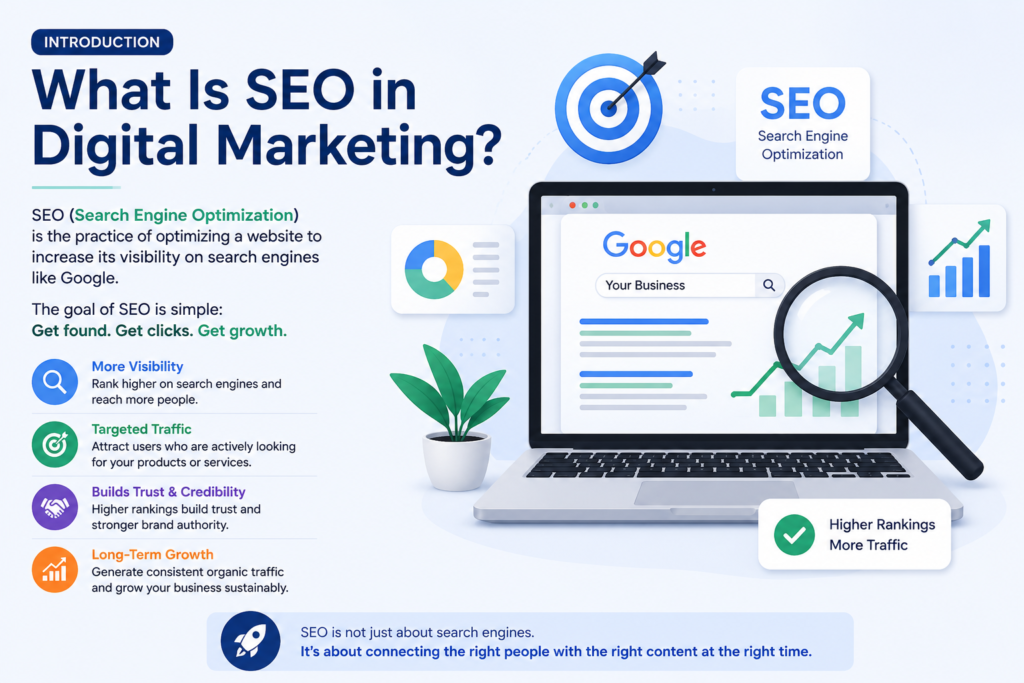
Imagine launching a beautiful website with valuable content, only to realize that no one can find it on Google. That’s where SEO in digital marketing becomes essential. Search Engine Optimization (SEO) is the process of improving a website’s visibility in search engine results, helping businesses attract relevant organic traffic without relying solely on paid advertisements.
In simple terms, the meaning of SEO in digital marketing is making your website easier for search engines like Google to discover, understand, and recommend to users searching for related information. Whether you’re a business owner, blogger, or aspiring digital marketer, understanding the SEO definition is the first step toward building a successful online presence.
The importance of SEO in digital marketing has grown significantly as billions of searches are performed every day. People turn to search engines to find products, services, answers, and solutions. If your website isn’t optimized, your competitors are more likely to capture those potential customers. That’s why understanding why SEO in digital marketing is important for business is no longer optional—it’s a fundamental part of every successful digital marketing strategy.
If you’re new to the concept, don’t worry. This guide covers the SEO in digital marketing basics for beginners, explains how SEO works, and shows how optimizing your website can improve visibility, build trust, and generate long-term organic traffic. By the end of this article, you’ll have a solid foundation to start your SEO journey with confidence. Want to learn SEO directly from Google? Google’s SEO Starter Guide provides official best practices for creating search-friendly websites.
SEO Explained: Breaking Down "Search Engine Optimization" in Simple Terms
What does SEO in Digital Marketing stand for?
SEO in Digital Marketing stands for Search Engine Optimization. It is the process of improving a website so that it appears higher in search engine results when users search for relevant keywords. The primary goal of SEO is to increase a website’s visibility, attract qualified organic traffic, and provide users with the most relevant information based on their search queries.
SEO involves optimizing various aspects of a website, including its content, technical performance, user experience, and authority. When implemented correctly, SEO helps search engines understand your website better and increases the likelihood of your pages appearing on the first page of search results. For example, if someone searches for “best digital marketing course in Bangalore,” Google displays the websites it considers most relevant and trustworthy. Websites that follow SEO best practices have a better chance of appearing higher in those results.
Types of SEO
Search Engine Optimization is a long-term digital marketing strategy that helps search engines discover, understand, and rank web pages. Unlike paid advertising, where businesses pay to appear in search results, SEO focuses on earning rankings naturally by creating valuable content and improving website quality.
SEO consists of several important areas:
- On-Page SEO: Optimizing content, headings, keywords, images, meta titles, and internal links.
- Off-Page SEO: Building website authority through backlinks, brand mentions, and digital PR.
- Technical SEO: Improving crawlability, site speed, mobile responsiveness, XML sitemaps, structured data, and website security.
- Local SEO: Optimizing a business for location-based searches such as “restaurants near me.”
Together, these practices improve search visibility and provide a better experience for both users and search engines.
How Search Engines Work?
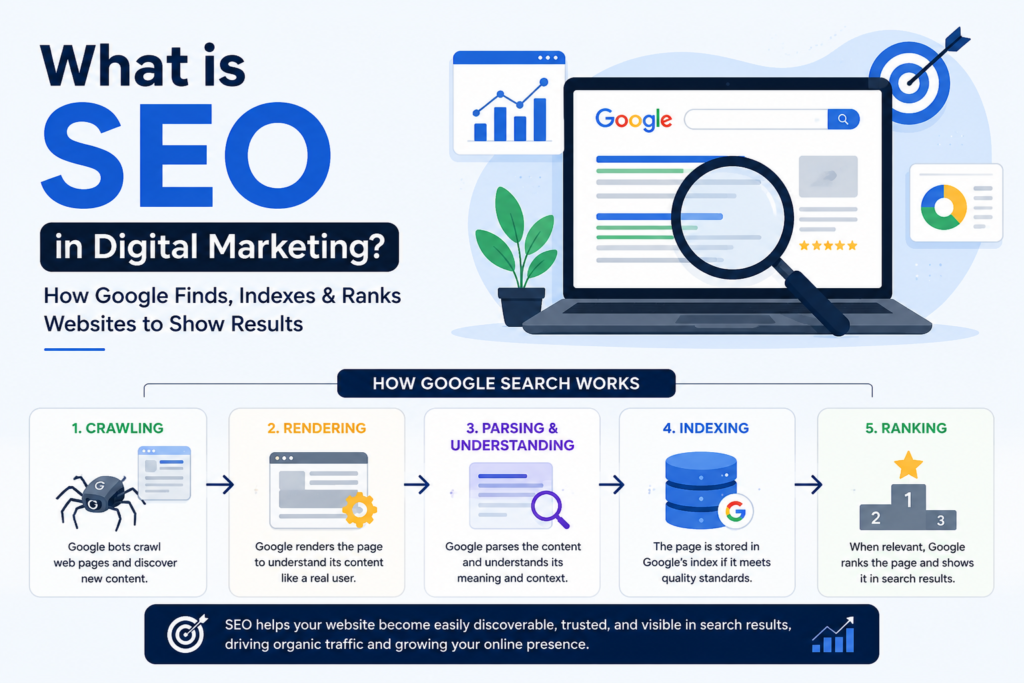
Search engines such as Google use automated programs called web crawlers or bots to discover and organize billions of web pages on the internet. Their goal is to provide users with the most relevant, accurate, and helpful information. Google follows a five-step process before displaying your website in search results.
Step 1: Crawling
Googlebot discovers web pages by following links from one page to another or by reading XML sitemaps submitted by website owners. During crawling, Google identifies new pages and checks existing pages for updates. If a page cannot be crawled because of issues such as robots.txt restrictions, broken links, or server errors, Google may not process it further.
Step 2: Rendering
Many modern websites use JavaScript to load content. During rendering, Google loads the webpage just like a browser would to see the complete page, including dynamic content, images, menus, and interactive elements. Rendering helps Google understand content that isn’t immediately visible in the HTML source code.
Step 3: Parsing and Understanding
After rendering, Google analyzes the webpage to understand its content and context. It identifies:
- Page title
- Headings
- Main content
- Images and alt text
- Internal links
- Structured data
- Keywords
- Overall topic of the page
Google uses advanced AI systems to determine what the page is about instead of simply counting keywords.
Step 4: Indexing
If the page meets Google’s quality standards, it is stored in Google’s massive database called the Google Index. Indexing means Google has saved information about your page and can now consider showing it in search results. Not every crawled page gets indexed. Duplicate content, poor-quality pages, or pages blocked with noindex may be excluded.
Step 5: Ranking
When a user performs a search, Google compares millions of indexed pages and determines which ones best answer the user’s query. Google evaluates hundreds of ranking factors, including:
- Content relevance
- Search intent
- Website authority
- Content quality
- Mobile friendliness
- Core Web Vitals
- HTTPS security
- Page speed
- User experience
- Backlinks
The pages that best satisfy the user’s intent appear higher in the search results. To understand Google’s crawling and indexing process in more detail, refer to Google’s official Crawling and Indexing Documentation.
The Core Pillars of SEO: On-Page, Off-Page, Technical, and Local SEO
SEO is made up of several components that work together to improve a website’s visibility in search engines. While all SEO activities have the same goal—helping your website rank higher on search engine results pages (SERPs)—they focus on different areas of optimization. The four core pillars of SEO are On-Page SEO, Off-Page SEO, Technical SEO, and Local SEO.
Each pillar plays a unique role in improving your search engine ranking. On-Page SEO focuses on optimizing your website’s content and structure, Off-Page SEO builds trust and authority through external signals, Technical SEO ensures your website is fast, secure, and easy for search engines to crawl, while Local SEO helps businesses appear in location-based searches. A successful website optimization strategy combines all four to improve visibility, user experience, and long-term organic growth.
On-Page SEO: Optimizing Your Content to Match What People Search For
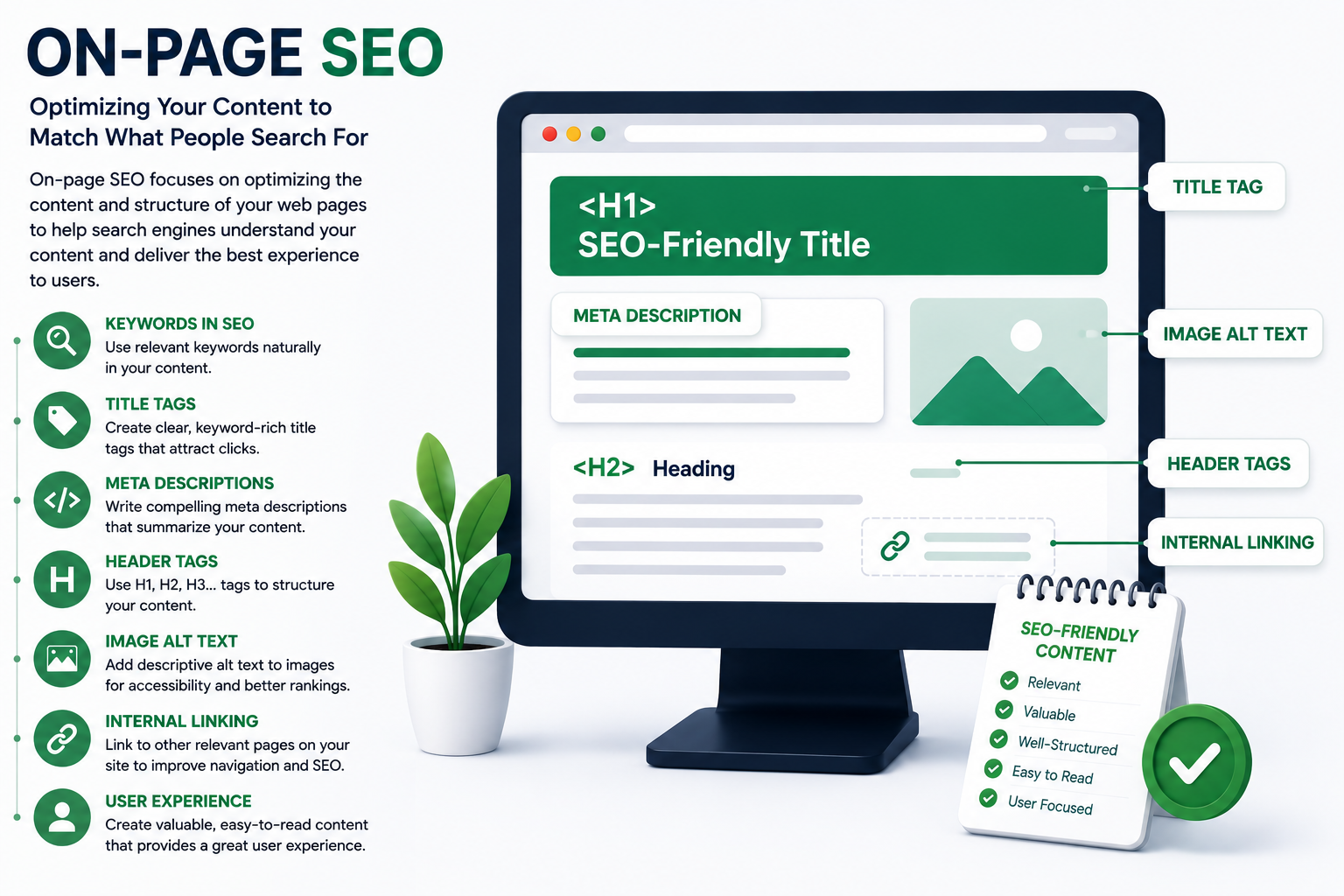
On-Page SEO is one of the most important components of SEO in digital marketing. It involves improving both the content and HTML elements of a page to help search engines understand what the page is about.
One of the most important aspects of On-Page SEO is keyword research, which helps identify the words and phrases users search for online. These keywords in SEO should be naturally included in important places such as the page title, headings, URL, and body content. However, using too many keywords, known as keyword stuffing, can negatively impact rankings. Instead of focusing on keyword density, modern SEO emphasizes creating helpful content that satisfies search intent—the reason behind a user’s search.
Other essential On-Page SEO elements include writing compelling title tags and meta descriptions, organizing content with header tags (H1–H6), adding descriptive image alt text, and connecting related pages through internal linking. Together, these practices improve SEO-friendly content, enhance the user experience, and help search engines understand your pages more effectively.
Off-Page SEO: Building Trust and Authority Beyond Your Website
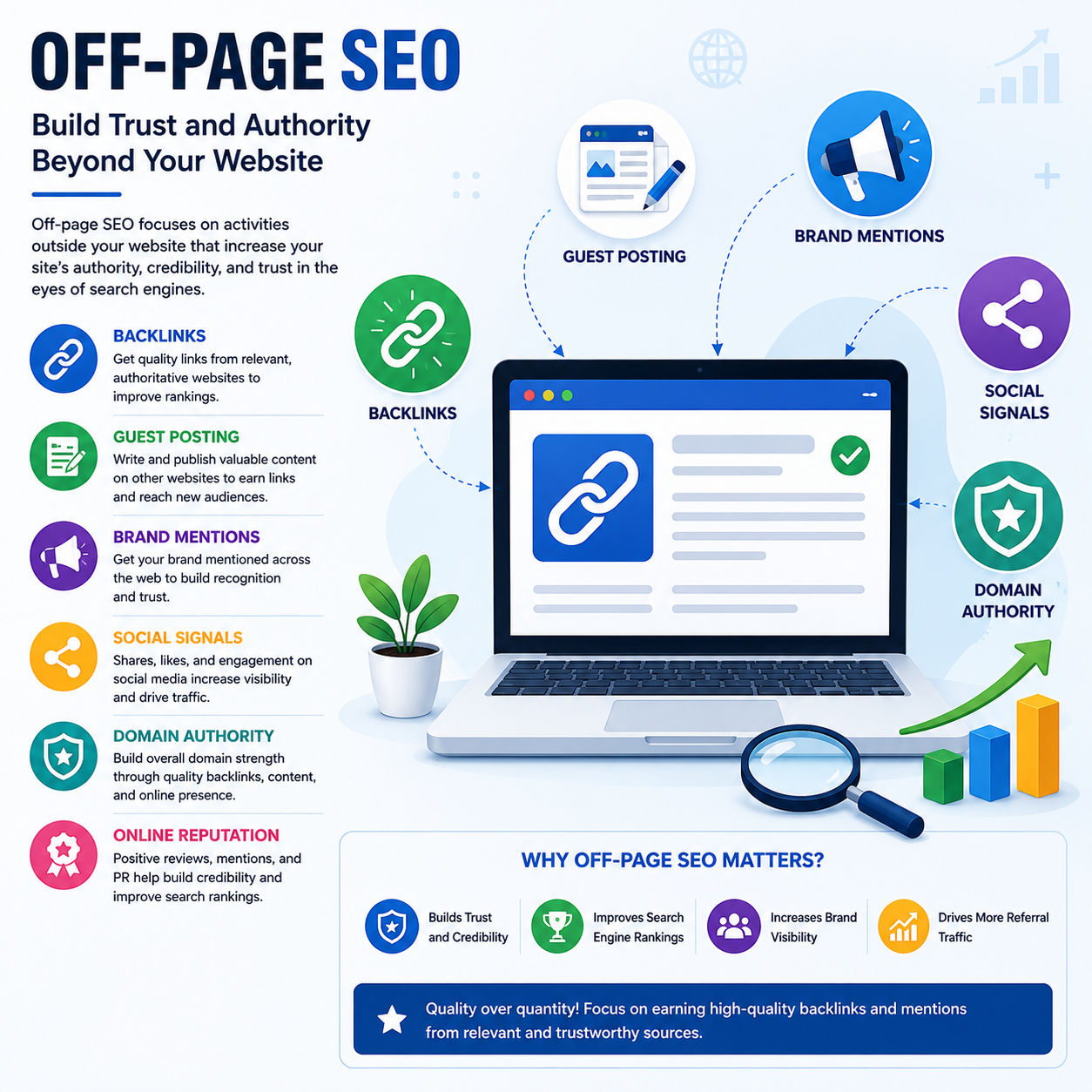
Off-Page SEO strengthens your overall SEO in digital marketing strategy by building trust and authority. Search engines consider these external signals as indicators of credibility and trustworthiness.
The most important Off-Page SEO factor is backlinks, which are links from other websites pointing to your pages. High-quality backlinks from reputable websites act as votes of confidence, helping improve your domain authority, page authority, and overall search engine ranking. Effective link building strategies include creating valuable content, guest posting, digital PR campaigns, and earning natural mentions from trusted websites.
In addition to backlinks, search engines also consider brand mentions, online reviews, and your overall online reputation. Although social signals such as likes and shares are not direct ranking factors, they can increase content visibility and lead to more backlinks. A strong Off-Page SEO strategy builds authority, increases trust, and helps your website compete for higher rankings.
Technical SEO: Making Sure Your Site Is Fast, Crawlable, and Mobile-Friendly
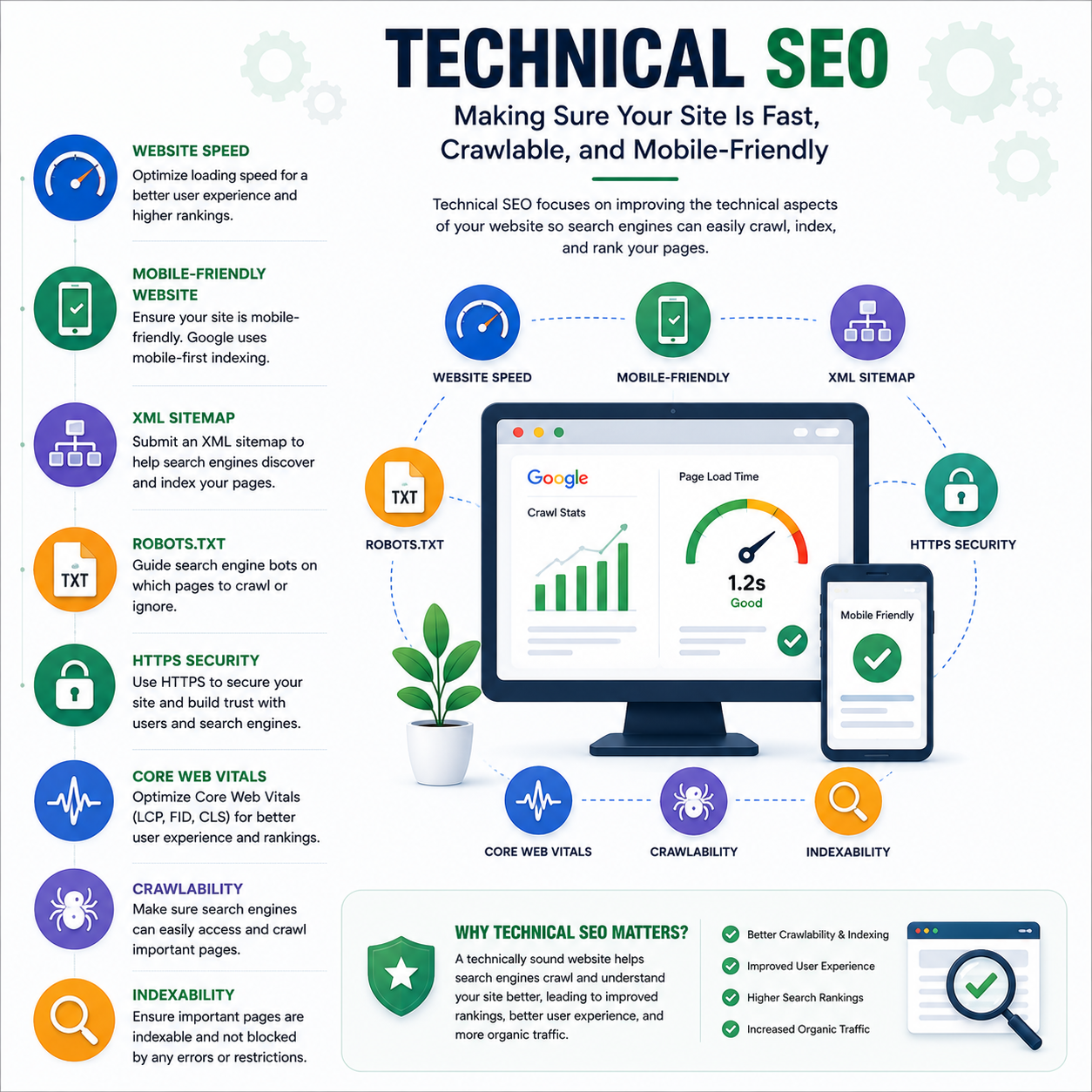
Technical SEO supports SEO in digital marketing by ensuring your website is fast, secure, crawlable, and easy to index. Even high-quality content may struggle to rank if a website has technical issues.
A well-optimized website should have a logical site structure, making it easy for both users and search engines to navigate. An XML sitemap helps search engines discover important pages, while the robots.txt file controls which pages should or shouldn’t be crawled. Ensuring proper crawlability and indexability allows search engines to access and include your pages in their search index.
Technical SEO also includes improving website speed, optimizing Core Web Vitals, using HTTPS security, and creating a mobile-friendly website. Since Google follows mobile-first indexing, it primarily evaluates the mobile version of a website for ranking purposes. Regularly following a technical SEO checklist helps identify and fix issues that may affect your website’s performance and search visibility.
Local SEO: Getting Found by Customers Near You
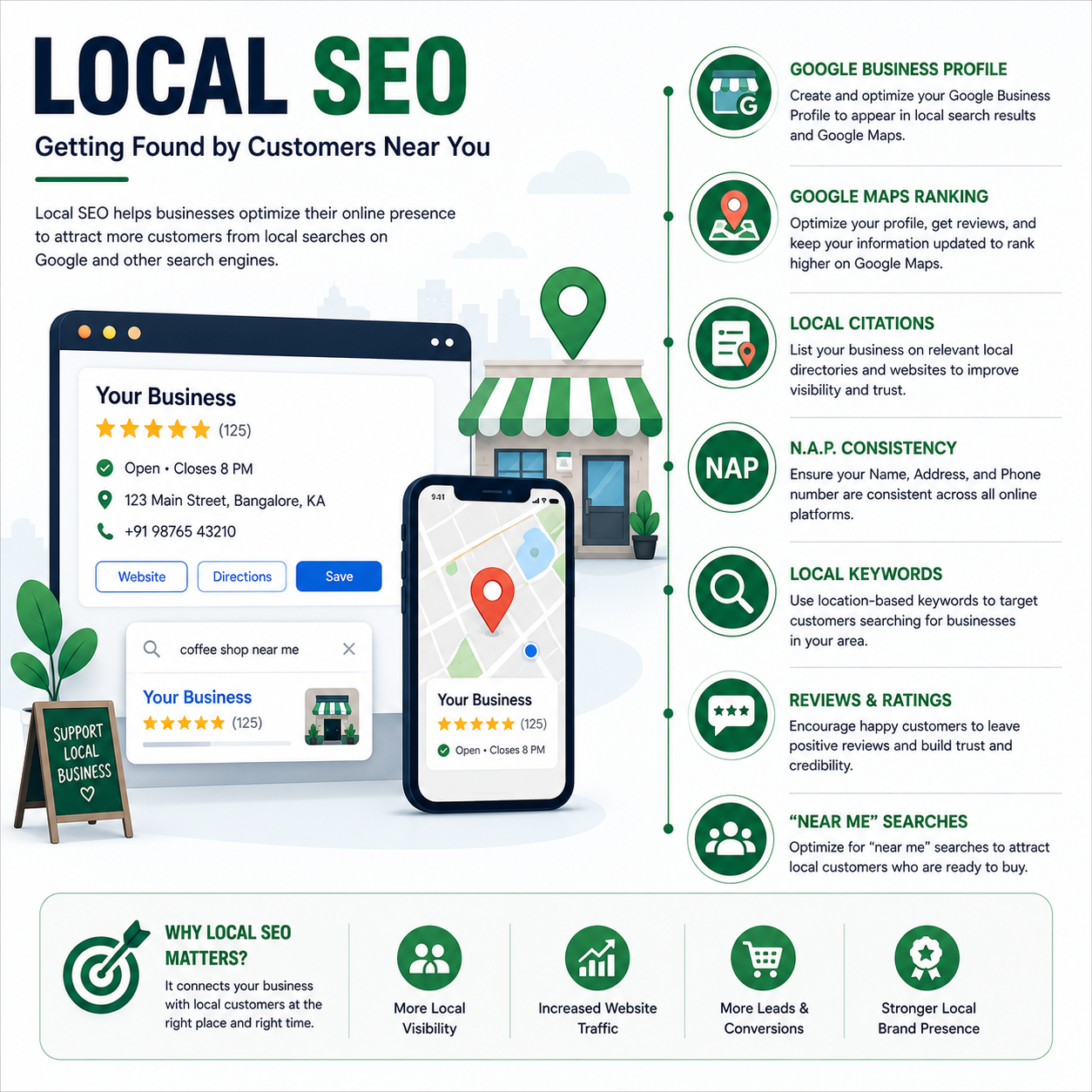
Local SEO is an important branch of SEO in digital marketing for businesses that serve customers in specific locations. It is the process of optimizing your online presence to attract customers searching for products or services in a specific geographic area. It is especially important for businesses that serve local customers, such as restaurants, clinics, gyms, salons, and retail stores.
A key part of local SEO for small businesses is creating and optimizing a Google Business Profile, which helps businesses appear in Google Maps and local search results. Maintaining accurate N.A.P. (Name, Address, Phone Number) consistency across your website and online directories builds trust with search engines and improves local visibility. Businesses should also target local keywords, such as “digital marketing agency in Bangalore” or “coffee shop near me,” to match users performing “near me” searches.
Additional Local SEO strategies include earning positive customer reviews, building local citations, creating location-specific content, and optimizing for local search intent. A strong local SEO strategy helps businesses attract nearby customers, increase foot traffic, and improve visibility within their target market.
SEO vs Paid Ads: Why Organic Search Is a Long-Term Growth Engine
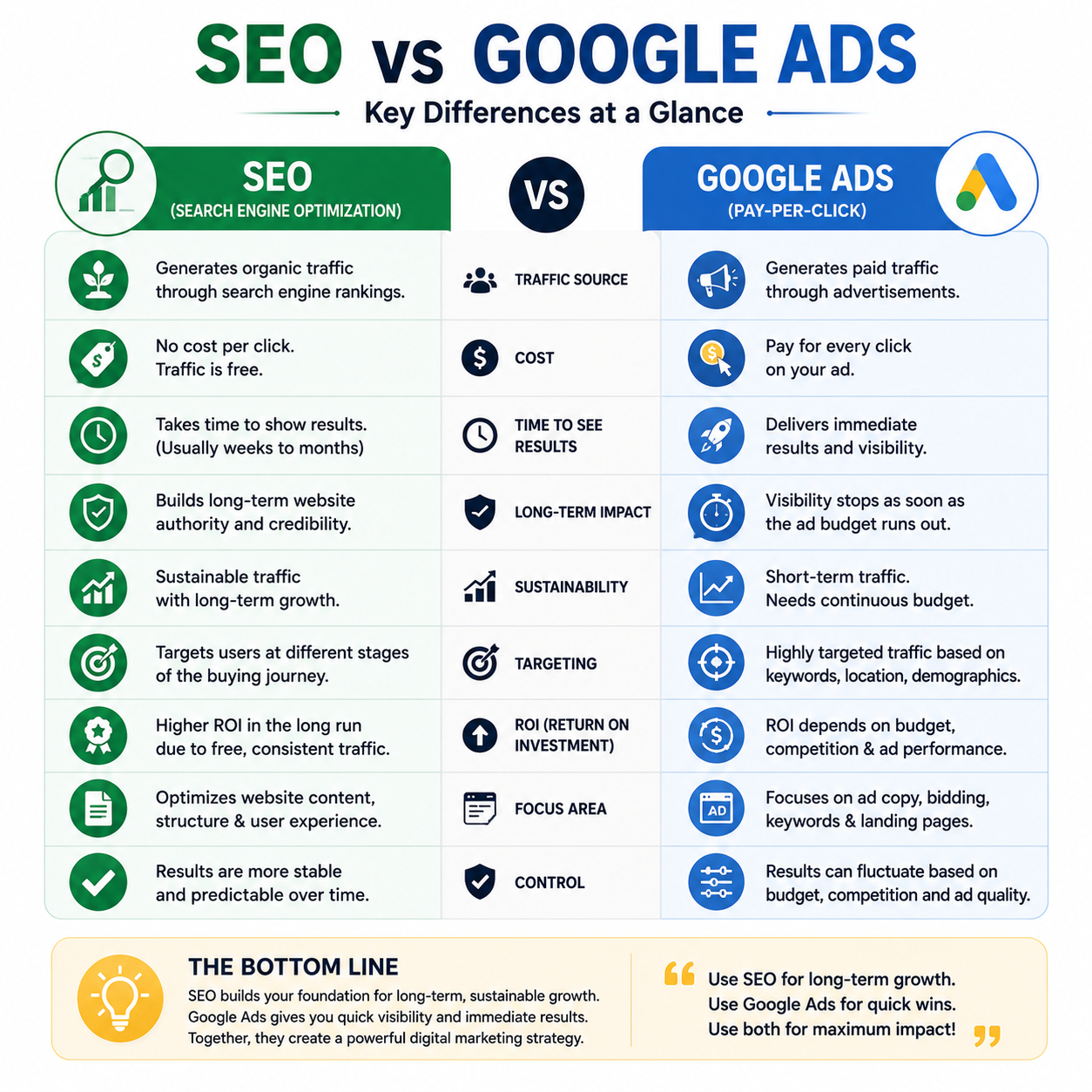
One of the biggest advantages of SEO is that it continues to drive visitors even after your content is published and optimized. This makes SEO one of the most cost-effective marketing strategies because the traffic you earn doesn’t require paying for every visitor. While Google Ads can provide instant traffic, SEO in digital marketing delivers sustainable organic growth and long-term business value. Although SEO takes time to produce results, it often delivers a higher return on investment (ROI) over the long term by attracting consistent, qualified traffic and building trust with users.
On the other hand, Google Ads is useful when you need immediate results, such as launching a new product, promoting seasonal offers, or driving traffic to a time-sensitive campaign. Since ads appear almost instantly, businesses can quickly reach potential customers, but traffic usually stops as soon as the advertising budget is exhausted.
The best approach isn’t choosing one over the other—it’s knowing when to use SEO vs ads. If your goal is long-term brand growth, authority, and sustainable traffic, SEO should be your foundation. If you need quick visibility or immediate leads, PPC is an excellent complement. Many successful businesses combine both strategies, using Google Ads for short-term wins while investing in SEO for lasting digital growth.
Conclusion
SEO in digital marketing is no longer just an option—it’s an essential part of every successful online business strategy. Whether you’re running a personal blog, a small business, or a large e-commerce website, investing in SEO helps you build a strong online presence and reach people who are actively searching for what you offer. Unlike paid advertising, which stops generating traffic when your budget runs out, SEO is a long-term strategy that delivers sustainable traffic, builds credibility, and provides lasting results.
The benefits of SEO in digital marketing extend far beyond higher search rankings. A well-optimized website improves user experience, increases brand visibility, attracts qualified visitors, and gives you a competitive advantage in your industry. As search engines continue to evolve, businesses that prioritize SEO today will be better positioned for long-term growth. If you’re just getting started, begin by learning the fundamentals, optimizing your website, creating valuable content, and monitoring your performance regularly. Every improvement you make brings you one step closer to turning visitors into customers and achieving sustainable digital success through SEO.
If you found this guide helpful, feel free to explore more of my work. Check out my portfolio to discover my latest SEO blogs, digital marketing projects, case studies, and the skills I’m continuously building as an aspiring digital marketer.